Protest in Delhi and Detention
The resistance against the proposed 11,200-MW Siang Upper Multipurpose Project [Arunachal Pradesh] in Arunachal Pradesh has now reached the national capital.
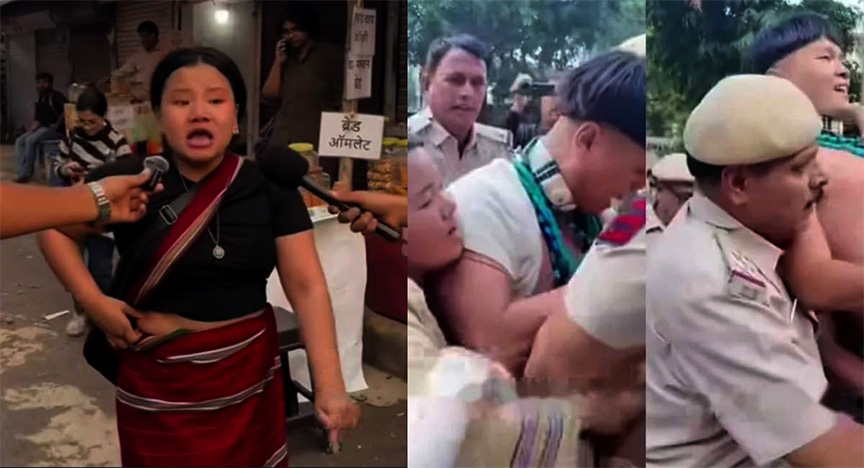
On Saturday, November 1, Delhi Police detained around 40 students, indigenous youths and activists who had assembled outside Arunachal Bhawan. The demonstration was organised by Himkhand and Youth for Change [YFC] Arunachal to oppose the mega dam and demand the release of those arrested during the ongoing anti-dam movement in Arunachal.
Protesters were demanding the withdrawal of the project, the release of anti-dam activists and villagers, the withdrawal of criminal cases against them, and the removal of Central Armed Police Forces [CAPF] deployed in the Siang region.
According to accounts shared with Maktoob Media, the demonstration had barely continued for 15 minutes before police began forcibly detaining participants. Among those detained was Katon Moyong, popularly known as Abor Man, an environmental engineer and prominent voice in the movement. Protesters alleged Moyong was manhandled while interacting with the media.
Allegations of Brutality and Irregular Detention
The detention was accompanied by disturbing allegations of physical and sexual assault. Vagheesha, a member of Himkhand, alleged that several protesters were subjected to sexual assault and inappropriate touching. “My shirt was lifted, I was pinched on my private parts and brutally pushed into the buses,” Vagheesha said, describing the treatment. The activist said indigenous people from Arunachal had come to Delhi to exercise democratic rights and raise concerns about ancestral land.
In a video recorded while being taken away in a police vehicle, another Himkhand member also alleged beating and sexual assault. Protesters said police did not initially disclose where they were being taken.
The manner of detention raised further concerns. Speaking to Maktoob, Kranti, another Himkhand member, said three police vehicles took protesters to different locations. Seven Northeast students were taken to Chanakyapuri Police Station, while others were reportedly taken towards Najafgarh, near the Delhi-Haryana border. Men and women were separated.
An independent journalist, Baksheesh Lamba, was also allegedly picked up and taken away in a separate vehicle and became unreachable.
According to the organisation, around 40 people were detained, with approximately 25-30 initially at Baba Haridas Nagar Police Station. Himkhand further alleged that women protesters were detained late into the night and were asked to sign forms under Section 35[3] of the Bharatiya Nagarik Suraksha Sanhita [BNSS]. Lawyers waited outside police stations as families tried to establish contact. Delhi Police had been approached for a response but had not responded at the time of initial reports.
Release After Congress Intervention
All detained youths and students have since been released following intervention by senior Congress leaders. According to Echo of Arunachal, APCC president Bosiram Siram, accompanied by AICC in-charges Dr A. Chellakumar and advocate Mathew Antony, visited Chanakyapuri Police Station to intervene.
Siram said the voices of Arunachal’s people could not be ignored and that young people must be allowed to exercise their constitutional right to peaceful protest. He stressed that concerns relating to land, identity, livelihoods, environment and the future of indigenous communities must be heard rather than suppressed.
The APCC had earlier condemned the detentions and demanded that police disclose legal grounds, communicate whereabouts to families, ensure no intimidation of peaceful demonstrators, and engage transparently with affected communities before proceeding with SUMP-related activities.
Background: The Crackdown in Arunachal That Triggered the Delhi Protest
The Delhi protest was an extension of a sustained movement in Arunachal. On October 23, youth groups and local organisations had called for a 12-hour bandh across Siang, Upper Siang and East Siang districts. The demonstration in Pasighat turned violent, with police deploying tear gas and stun grenades. Angry protesters allegedly vandalised and set fire to police vehicles, an NHPC office and residences of political leaders, including local BJP MLAs and the state BJP president.
Following the violence, the Arunachal Pradesh government intensified security and initiated arrests under stringent provisions, including the Arunachal Pradesh Unlawful Activities [Prevention] Act [APUAPA]. Dozens were arrested or detained, with families raising concerns that ordinary residents who had participated in peaceful demonstrations were also affected.
The deployment of more than 30 companies of CAPF has heightened tensions. The security presence has been linked to efforts to facilitate preliminary project exercises, including preparation of a Pre-Feasibility Report [PFR].
The crackdown has reportedly extended to government employees and traditional village institutions. The APCC has expressed concern over suspension of employees and action against gaon buras, or traditional village headmen, who opposed the project.
Why Indigenous Communities Are Resisting SUMP
The SUMP, being pursued by the Centre through NHPC, is envisaged as one of India’s largest hydropower and multipurpose storage initiatives. The Centre has invoked strategic, water-security and flood-management considerations, particularly in the context of China’s proposed large hydropower development on the Yarlung Tsangpo in Tibet, which flows into India as the Siang.
For indigenous communities, the project concerns destruction of ancestral settlements, displacement, loss of agricultural land and forests, ecological disruption and erosion of a way of life connected to the river.
Reports indicate as many as 27 villages could face submergence, with several dozen more potentially affected. For the Adi community, the Siang, revered as Ane Siang or Mother Siang, is central to cultural memory, identity, livelihood and community life.
Organisations such as the Siang Indigenous Farmers’ Forum [SIFF], Adi Bane Kebang United and various student and youth groups have questioned the project and demanded consent of affected communities be taken seriously.
Chief Minister Pema Khandu has maintained that the government is presently seeking cooperation only for preparation of the PFR and that the project will not be imposed without public consultation. Activists have questioned how meaningful consultation can take place when opponents are being arrested, cases registered, and security forces deployed. SIFF spokesperson Tagori Mize has also questioned the government’s willingness for genuine dialogue while protesters remain behind bars.
Demand for Withdrawal
The APCC has demanded that SUMP be scrapped, all arrested be released, cases under APUAPA be withdrawn, suspension orders against employees revoked, and action against traditional headmen withdrawn.
The party has maintained that no development project should proceed at the expense of indigenous communities’ ancestral land, identity, culture and livelihoods. It has called for removal of additional security personnel, compensation for losses, and medical assistance and rehabilitation for injured protesters.
The APCC emphasised that assurances about public consultation must translate into democratic engagement and argued that strategic considerations cannot justify disregarding indigenous rights or bypassing free, prior and informed consent [FPIC]. It urged the Centre and state government to restore peace through dialogue rather than treating opposition as a law-and-order problem.
“Different groups but one voice; different organisations but one collective resolve — Stop SUMP, Save Siang,” the APCC said in its appeal for solidarity.